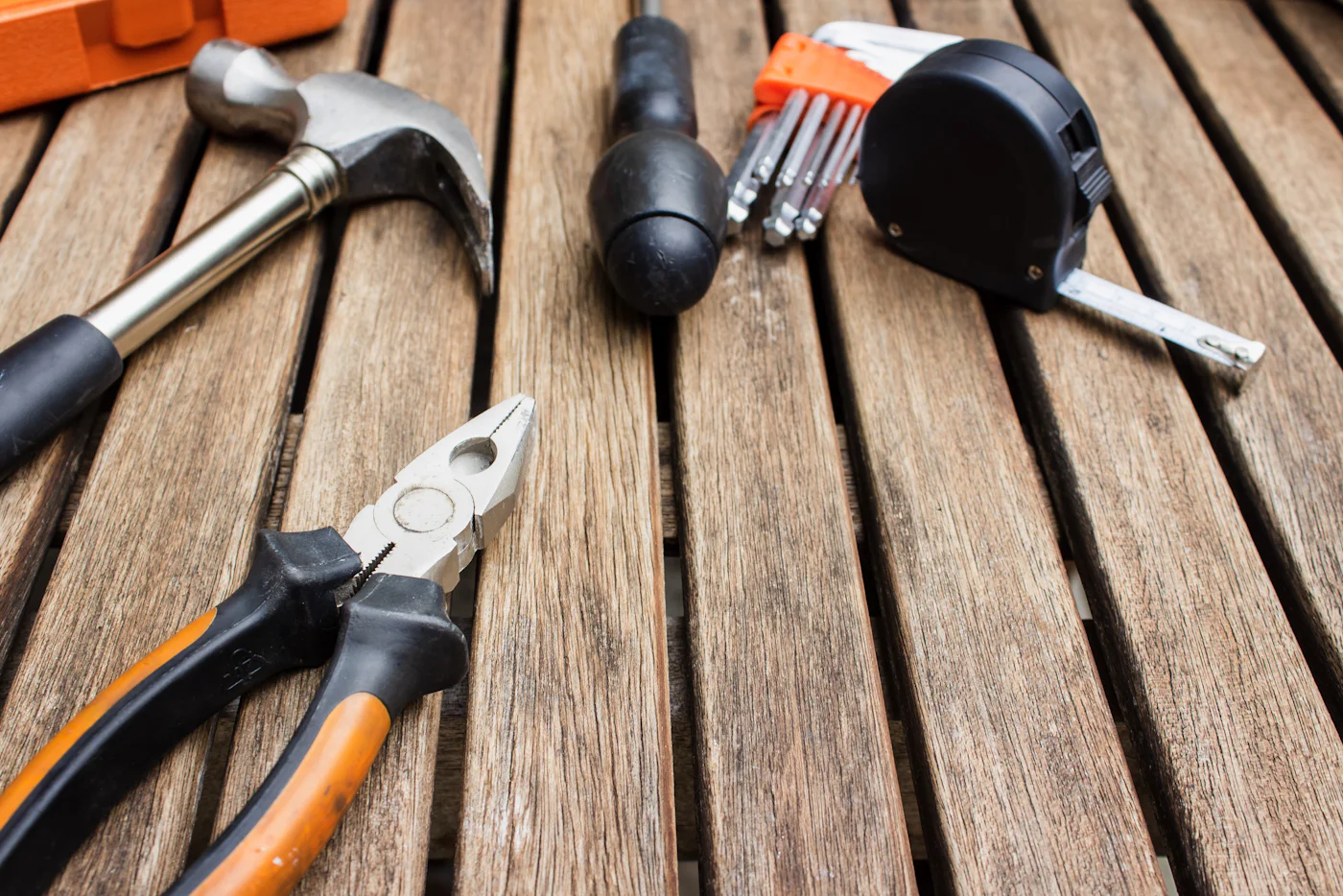
What to skip: Skip the 200-piece homeowner kit in a plastic case. It’s mostly bits and sockets you’ll never use, wrapped around a few tools too cheap to trust. Buy the starter kit below one decent tool at a time instead, and add the rest when a job calls for it.
1
Enough to hang, tighten, measure, and fix most of what breaks in a normal year. Buy these first.The starter kit
Cordless drill and driver
Drills holes and drives screws: shelves, curtain rods, furniture, new hardware. A drill with two batteries and a basic set of drill and driver bits covers nearly every household job.Tape measure
A 25-foot tape with a stiff blade. You’ll use it more than anything else on this page.Claw hammer
A 16-ounce hammer for picture hooks, trim nails, and pulling what shouldn’t be there.Screwdrivers
Phillips and flat in a few sizes, or a multi-bit driver that stores its own bits, plus a small precision set for battery covers and glasses.Pliers
Slip-joint and needle-nose to start, and a pair of tongue-and-groove pliers for the big plastic nuts under sinks.Adjustable wrench
An 8- or 10-inch wrench for faucet supply lines, bolts, and anything hex-shaped.Utility knife
Opening boxes, scoring drywall, trimming caulk and carpet. Get one with replaceable blades and keep spares.Level
A 24-inch level for shelves and pictures, and a small torpedo level for tight spots.Headlamp
Keeps both hands free under a sink, in a crawl space, or at the electrical panel during an outage.Safety glasses and work gloves
For drilling overhead, cutting, and anything that throws debris or has sharp edges.2
The tools behind the recurring jobs: the dryer vent, the drains, the caulk, the filters, and the outlet tests.For the maintenance a house needs
Wet/dry shop vacuum
Clears dryer vent ducts, AC condensate lines, clogged drains, and small floods. Once you own a house, it’s the tool you’ll be gladdest you bought.What to do after buying a houseDryer vent brush kit
Flexible rods and a brush that spin in a drill to clear the whole vent duct once a year, not just the lint screen.Caulk gun
Sealing tubs, sinks, windows, and exterior trim, one of the cheapest ways to keep water and drafts out.Plunger and drain snake
A flange plunger for toilets and a hand drain snake for slow sinks and tubs, before you pay for a plumber’s visit.Step ladder
A 6-foot ladder for smoke detectors, light fixtures, and ceiling fans. Add an extension ladder only if you’ll clean your own gutters.Voltage tester and outlet tester
The voltage tester confirms a wire is dead before you touch it; the outlet tester checks wiring and trips GFCI outlets for their test.Thread seal tape
For showerheads, hose fittings, and other threaded connections that drip.3
Buy these before you need them, and keep them where everyone can find them.For emergencies
Fire extinguishers
An ABC-rated extinguisher in the kitchen and on each floor. Check the gauge once a year and replace one that’s been used or is past its date.Gas shutoff wrench
Turns the valve at the gas meter in an emergency. Keep it next to the meter.How to shut off your water, gas, and electricityWater leak sensors
Small battery alarms under the water heater, the washer, and the sinks that sound at the first drop. Wi-Fi versions alert your phone when you’re away.4
Tools you’ll use once or twice a year cost more to own than to rent. Most home centers rent them by the hour or the day.